
Shropshire funding per person set to fall to 29% less than national average
New analysis from the Rural Services Network has revealed a growing and structural funding gap between Shropshire, comparable rural councils, and the national average – highlighting the increasing financial pressure facing the county.
The figures show that Government funding for Shropshire is set to fall by around 10% between 2025/26 and 2028/29, compared to a smaller 4% reduction across rural authorities and a 10% increase nationally.
When looked at on a per-person basis, the disparity becomes even more pronounced.
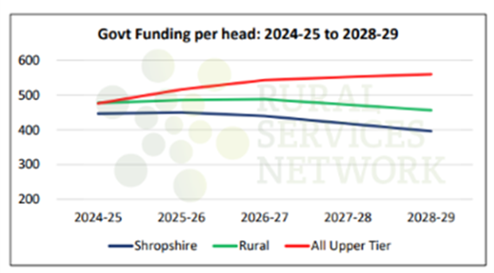
A graph showing government funding per head of population as part of an analysis by the Rural Services Network.
In 2025/26, Government funding in Shropshire stands at around £450 per head, already below both the rural average of £485 and the national upper-tier average of £516.
By 2028/29, this falls significantly further to £396 per head in Shropshire, compared to £456 in rural areas and £559 nationally.
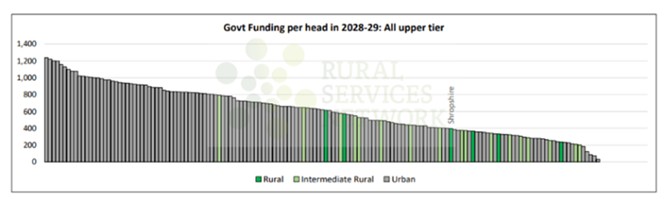
A graph showing government funding per head in 2028-29, all upper tier as part of an analysis by the Rural Services Network.
This means:
- Shropshire starts around 7% below rural councils and 13% below the national average.
- By 2028/29, this is set to widen to around 13% below rural councils and 29% below the national average.
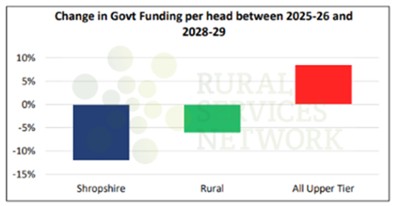
A graph showing the change in government funding per head between 2025-26 and 2028-29 as part of an analysis by the Rural Services Network.
In cash terms, the gap is also growing significantly:
- The per-head gap between Shropshire and rural councils increases from around £36 per person to over £60.
- The gap with the national average more than doubles, rising from around £66 per person to over £160.
This represents a clear and accelerating divergence, not just a static disadvantage.
While Council Tax income will rise, these increases will not even cover the scale of the reduction in Government grant, leaving a structural funding gap that must be managed locally.
At the same time, Shropshire’s population is expected to grow and age, increasing demand for essential services such as adult social care, children’s services and maintaining the council’s nearly 3,200 miles of roads. Delivering these services costs more in Shropshire than most places due to the demography and level of rurality, even though in many cases they are delivered to a more efficient per head cost than in other places.
For example, there have been two independent reviews of Adult Social Care by the Local Government Association (LGA) in recent months, both of which report an average spend when compared with other local authorities and particularly the council’s statistical neighbours.
While managing demand for these essential services has largely been successful, costs can remain a pressure driven by inflation, complexity and delivery of care across a large county. This means the overall cost to taxpayers is higher, even with notable local efficiencies.
This demonstrates that Shropshire is facing a triple squeeze of falling Government support at a faster rate than similar councils, combined with a widening gap in funding per resident compared to both rural peers and the national picture and demographic factors leading to higher costs to maintain core services.
Shropshire Council has already declared a financial emergency and is working to restore long-term sustainability after years of structural imbalance. It is now continuing to change through a wide-ranging programme of transformation, including service redesign and an emerging programme of devolution to Town and Parish Councils – helping protect frontline services while giving communities greater control over local priorities.
Speaking about the findings, Shropshire Council’s Deputy Leader, Councillor Alex Wagner, said:
“This analysis shows that Shropshire is being short-changed, and that the gap is getting worse rather than better. We already receive less funding per head than comparable areas, and by the end of this period that gap grows to around £160 per person compared to the national average – 29% lower in fact.
“That is a significant and sustained disadvantage for a county like ours, where demand is rising and services cost more to deliver. Even with increases in Council Tax and other fees, we cannot make up for reductions of this scale in Government funding.
“We are taking the difficult decisions needed locally to restore financial responsibility, use taxpayers’ money wisely, and protect services, but this analysis only strengthens the case for a fairer national funding system – one that properly recognises rural areas like Shropshire. It also shows the scale of the challenge to change and improve in everything we do.”
The full analysis, produced by the Rural Services Network, is available Rural Services Network analysis April 2026.