
New sensors to monitor and help manage peatlands
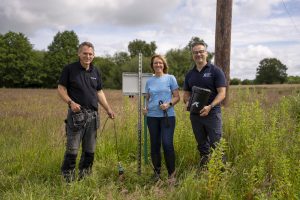
Matthew Ellison, of sensor provider Kisters, with Councillor Sarah Marston and Matt Smith, RSPAWIR programme manager
New sensor technology is being rolled out across peatland sites in north Shropshire to help farmers better understand and manage these environmentally important landscapes.
Delivered through the River Severn Partnership Advanced Wireless Innovation Region (RSPAWIR), and the Marches Future Farming Group, which is part of the Severn Valley Water Management Scheme demonstrator programme, the project will install a network of wireless sensors across multiple peatland fields, providing real-time data on groundwater levels and soil conditions.
Peatlands are vital for carbon storage, water management and biodiversity but are vulnerable to drying out, particularly during prolonged dry periods. The new technology will allow conditions to be monitored remotely and in real time, improving understanding of how peatland systems respond to changing weather and land use.
This will give farmers and land managers a clearer picture of how their land is functioning and support more informed decision-making.
Sarah Marston, Shropshire Council cabinet member with responsibility for the environment, said:-
“North Shropshire contains large areas of lowland peat. This is highly productive farmland, but across the country it also stores around 3% of the UK’s greenhouse gasses.
“With climate change leading to longer drier periods, these gasses will be released if the peat loses its moisture. It’s fantastic to see our farming community responding to this challenge by working together and utilising innovative technology.”
Matt Smith, programme manager for RSPAWIR, said:-
“This project is just one of a range of water-based agri-tech use cases that have been funded by the RSPAWIR. It fits into a wider project, initiated by the Shropshire Wildlife Trust that will collectively see 125 hectares of lowland peat monitored using wireless technology.”
The system combines groundwater and soil moisture sensors, carefully positioned to detect changes in water levels and transmit data continuously. By bringing these datasets together, farmers and partners will gain a more detailed understanding of how water moves through each field, supporting more effective land management.
Kate Mayne of the North Shropshire Farmers’ Group, which is leading the project for the Marches Future Farming Group, added:-
“By improving understanding of peat condition, the work will help reduce carbon loss from degraded peat, strengthen the evidence base for restoration and support more resilient farming systems.
“We are looking for insights as the project develops, including how real-time data can support practical decisions to maintain moisture levels, protect productivity and enhance biodiversity.”
About the RSPAWIR: The RSPAWIR, managed by Shropshire Council, has received £4 million in funding from the Department for Science, Innovation and Technology to support the growth of advanced wireless innovation across key economic sectors and is one of ten innovation regions nationally to receive funding.
RSPAWIR focuses on accelerating the adoption of advanced wireless technologies across three sectors with strong roots in the catchment area: water management, agri‑tech and the public sector.
About the SVWMS: The SVWMS is a cross-border initiative led by the Environment Agency, in partnership with Natural Resources Wales, Powys County Council, and Shropshire Council, and funded by Defra. Its aim is to develop a holistic water management strategy for the upper Severn, which could serve as a model for similar projects nationwide.