Shropshire report shines a light on hidden rural poverty and sets out action to tackle health inequalities
Shropshire Council has published its Director of Public Health Annual Report 2026, highlighting the growing impact of poverty, financial hardship and deprivation on health and wellbeing across rural communities.
The report, More Than Money: How Poverty Shapes Lives, Places and Health, examines the drivers of poverty in Shropshire and sets out a programme of action to reduce inequalities and improve outcomes for residents. It has been published alongside the agenda papers for the Health and Wellbeing Board meeting taking place on 19 November, where members will consider its findings and recommendations.
The report argues that poverty remains one of the most significant public health challenges facing the county, influencing physical and mental health, educational attainment, employment opportunities and life expectancy, and is a shared responsibility to work together to tackle.
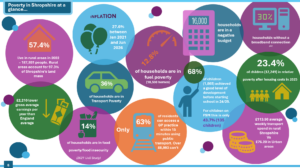
An infographic from the report gives an insight into poverty in Shropshire
The publication comes shortly after the Chief Medical Officer for England’s report, Health in Rural Areas and Small Towns, which highlighted the growing importance of addressing the wider determinants of health in rural communities. With Shropshire included as a national case study, the annual report provides a detailed local perspective on many of the same challenges, including hidden poverty, access to services, fuel poverty, housing affordability and demographic change.
While Shropshire is often perceived as a prosperous county, the report highlights how poverty can be less visible in rural areas, where higher living costs and barriers to accessing services can leave residents struggling despite appearing financially secure.
Among the report’s findings:
- More than half of Shropshire’s population (57.4%) live in rural areas, where residents often face additional costs associated with transport, heating, housing and accessing essential services.
- Around 18,500 households are estimated to be living in fuel poverty, significantly above the England average.
- An estimated 23.4% of children are living in relative poverty after housing costs.
- Research cited in the report suggests around 14% of households experience food insecurity, while a Citizens Advice study found the cost of a basic shopping basket in south Shropshire had increased significantly since 2022.
- Transport remains a major challenge, with 36% of households classed as experiencing transport poverty and many residents facing difficulties accessing services, employment and healthcare.
The report also highlights the strong links between poverty and health outcomes, noting that social, economic and environmental factors account for the majority of health outcomes and inequalities experienced by communities.
A focus on prevention and partnership
Alongside its analysis of the challenges facing residents, the report sets out the action already underway across Shropshire through partnerships between the council, NHS organisations, voluntary and community sector partners, and local communities.
This includes the delivery of the new Crisis and Resilience Fund, investment in welfare and payment schemes, financial advice and resilience services, programmes to tackle fuel poverty, and initiatives designed to improve support for children, families and vulnerable residents before problems escalate.
The report emphasises that reducing poverty requires action across the wider determinants of health, including housing, transport, employment, education and access to services, rather than relying solely on healthcare interventions.
Recommendations for the future
Looking ahead, the report identifies seven priorities for action:
- Give every child the best start in life through programmes including Best Start in Life and the Family First Partnership Programme.
- Improve household financial resilience by expanding benefit advice, income maximisation support and early intervention.
- Strengthen a “No Wrong Door” approach so residents can access joined-up support regardless of where they first seek help.
- Reduce fuel poverty through affordable warmth programmes, retrofit schemes and targeted support for off-grid communities.
- Improve access to good-quality employment and skills, supporting residents into secure and better-paid work.
- Address rural inequalities by designing services around the realities of rural living, improving transport and digital inclusion, and advocating for fairer funding.
- Improve identification of hidden poverty through better use of data, earlier intervention and ongoing work to tackle stigma associated with seeking support.
The report also reinforces Shropshire’s ambition to become a Marmot Place, embedding health equity into decision-making and supporting a Health in All Policies approach across the council and its partners.
Rachel Robinson, Director of Public Health at Shropshire Council said:
“Growing up as a child who experienced the impact of poverty, this is a very personal report for me. Poverty in rural areas is often hidden, but its impact on people’s lives, health and opportunities is very real. This report highlights the challenges facing many residents across Shropshire, while also demonstrating the value of prevention, partnership working and early intervention and how this really does change lives.”
Councillor Ruth Houghton, Shropshire Council’s Cabinet member for health and social care said:
“Reducing poverty is not simply about increasing income. It is about enabling people to live healthy, secure and fulfilling lives. By tackling all the other factors that influence health and working collaboratively across organisations and communities, we can reduce inequalities and give everybody in Shropshire the opportunity to thrive, for generations to come.”
Read the report, published as part of the agenda for Health and Wellbeing Board taking place on Thursday 19 November 2026: 5. Appendix A. DPH Annual Report 2026.pdf