
Historic town walls feature unveiled at Riverside Gardens
Residents and visitors to Shrewsbury will soon be able to discover a hidden piece of the town’s history when Riverside Gardens opens in December, thanks to a new heritage feature unveiled yesterday (Wednesday 23 September 2026) as part of the Government-grant-funded Smithfield Riverside redevelopment.
The feature marks the line of the historic English Civil War-era Roushill Wall, remnants of which were uncovered during demolition and archaeological investigations on the site. These walls were buried by Victorian builders when the site was developed as a Livestock Market that opened in 1850 and remained in place until 1959 when it was relocated to Harlescott.
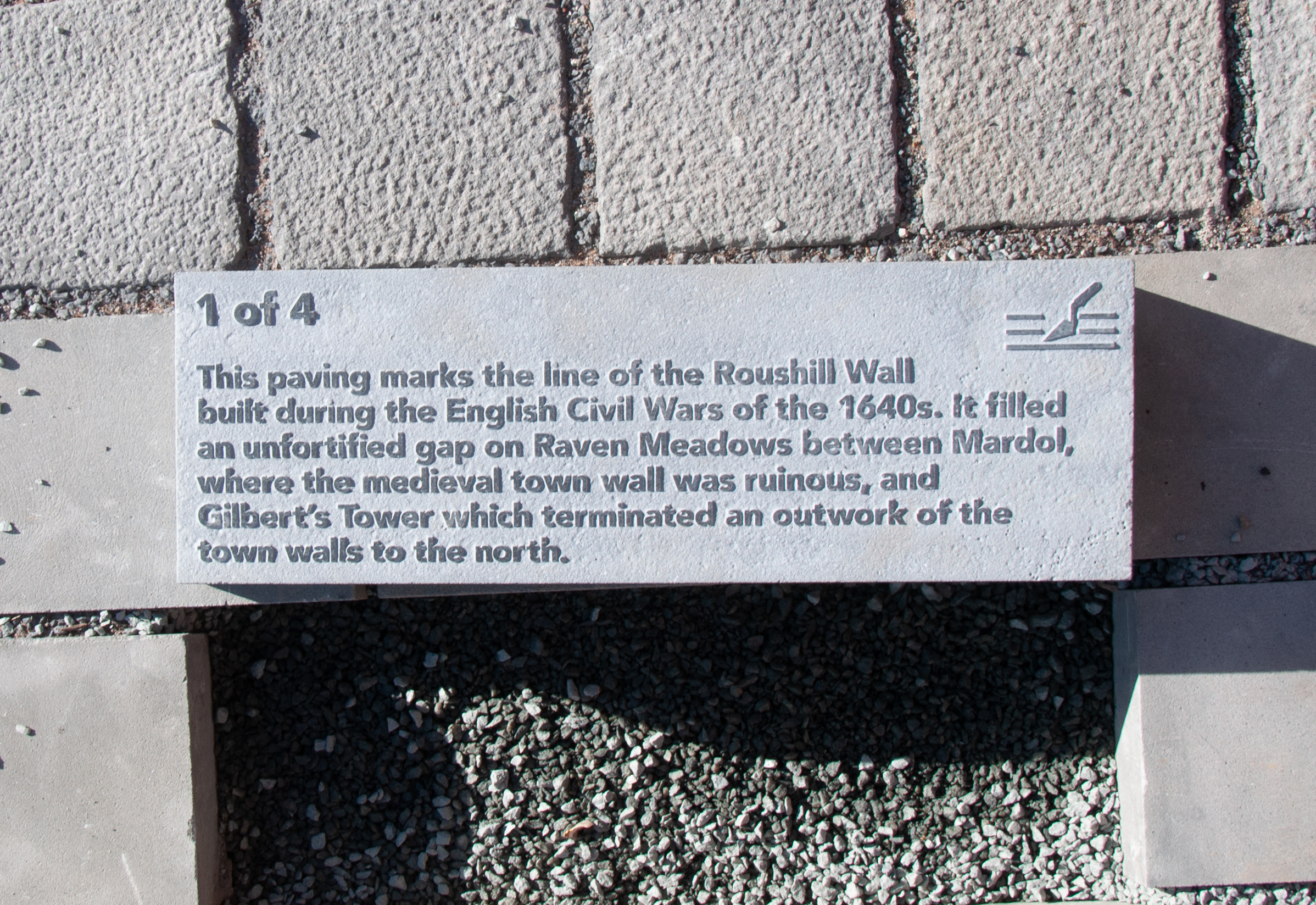
The first plaque, explaining the history of the site.
Working closely with the Shrewsbury Civic Society, a long-standing stakeholder in the Smithfield Riverside Redevelopment programme, Shropshire Council and contractor Morgan Sindall Construction have incorporated the location of the buried 17th century defence wall into the new paving design within Riverside Gardens. The feature is a series of four plaques set into the paving, close to the brick arcade arches and lift structure, which explain the significance of the remains.
Representatives from Shropshire Council, Morgan Sindall Construction and the Shrewsbury Civic Society gathered to unveil the new installation, which adds an extra layer of understanding to the site and helps connect the town’s past with its future.
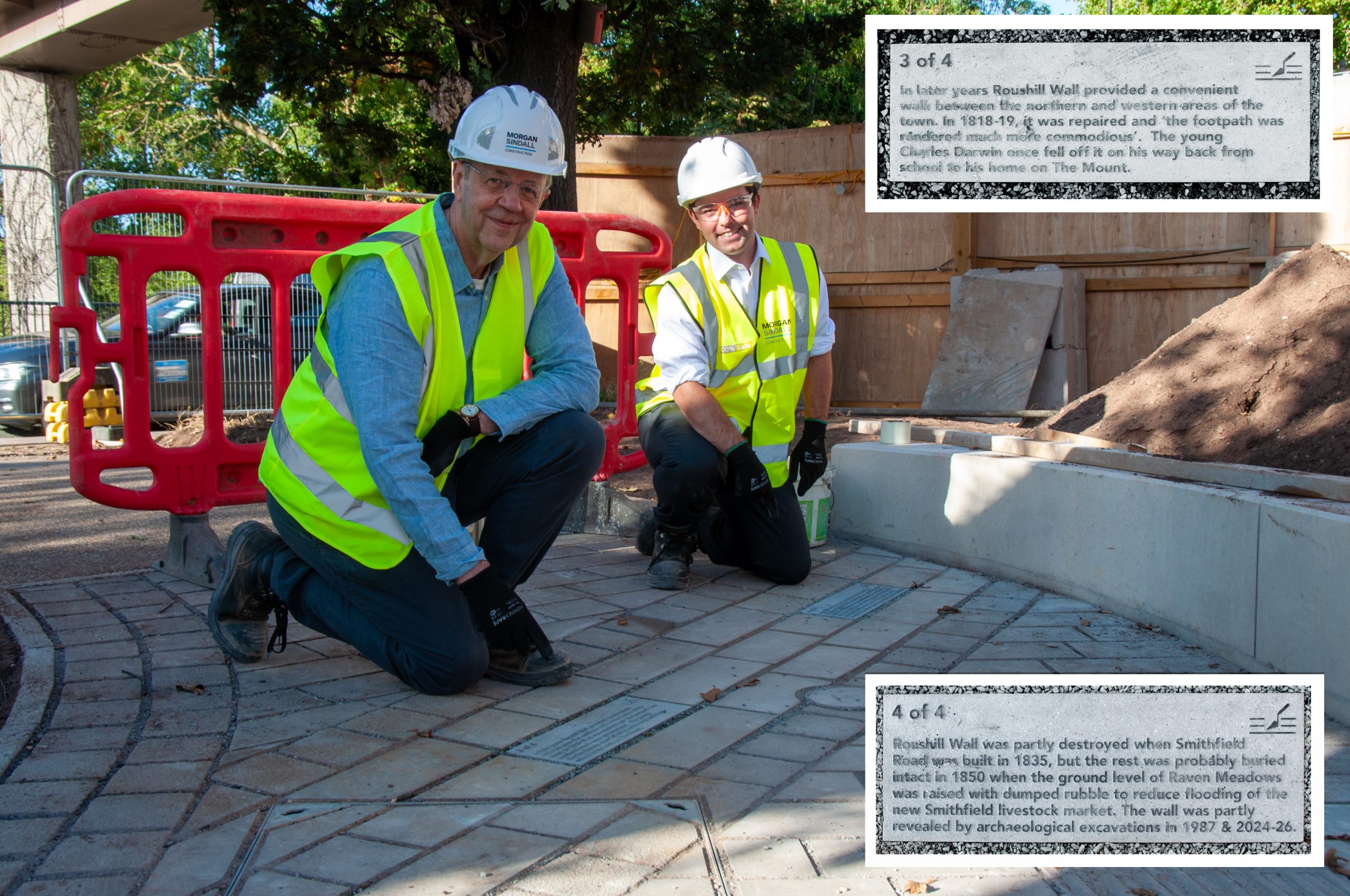
Councillor Alex Wagner and Phil Scoggins from Shrewsbury Civic Society unveil the new Town Walls heritage feature at Riverside Gardens, highlighting a section of Shrewsbury’s historic past discovered during the Smithfield Riverside redevelopment.
The initiative reflects the collaborative approach that has shaped the Smithfield Riverside redevelopment, ensuring that important elements of Shrewsbury’s heritage are recognised and celebrated alongside the creation of new public spaces.
The new feature will enable residents and visitors to better understand the historic development of the town while exploring Riverside Gardens, which is being delivered as part of the wider regeneration of the riverside area.
The work is being funded using £18.7 million of Levelling Up money from the UK Government which was awarded to the council in January 2023.
Councillor Alex Wagner, Shropshire Council’s deputy leader and Cabinet member for transformation and economic growth, said:
“The Smithfield Riverside redevelopment is about much more than creating new public spaces. It is about reconnecting people with this important part of Shrewsbury and celebrating the rich history that lies beneath our streets. We are delighted to have worked with the Shrewsbury Civic Society and Morgan Sindall to incorporate this fascinating discovery into Riverside Gardens, allowing future generations to appreciate an important chapter in the town’s story.”
Phil Scoggins, chairman of the planning committee at Shrewsbury Civic Society, said:
“We have long advocated for greater recognition of Shrewsbury’s historic built environment, and we are pleased that the remains of the Roushill Civil War wall have been acknowledged in this way. This feature will help residents and visitors better understand the town’s heritage and the many layers of history that exist beneath the modern streetscape.”
Nick Lawley, Riverside Gardens site manager at Morgan Sindall, said:
“Discoveries such as this help make projects like Smithfield Riverside truly unique. We are proud to have worked with our partners to preserve and interpret this important historic feature as part of the delivery of Riverside Gardens.”
History of the site provided by Shrewsbury Civic Society
The Roushill Wall along with alterations to the Castle represents the major built legacy of the English Civil Wars of the 1640s to the town. It was an attempt by the town’s defenders, initially Royalists then Parliamentarians after they captured the town to plug a gaping hole in the town’s defences across Raven Meadows.
In later years it provided a useful short cut from the north of the town to the Welsh Bridge. The young Charles Darwin was injured when he once fell off it on his way home from school (now the library) to his home on The Mount.
The wall disappeared as a town landmark when it was buried under several metres of rubble when the level of Raven Meadows was artificially raised to create the Smithfield livestock market in the 1850s. Yet, the Roushill Wall is still there. Most of it is probably under the ground and a stretch of it was uncovered in the 1980s and again this year during works to create the new Riverside Gardens.