
New exhibition explores centuries of civic buildings in Shrewsbury and Shropshire
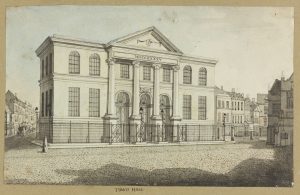
The 18th Century Shirehall which opened in 1785
A new exhibition at Shrewsbury Museum & Art Gallery celebrates the remarkable civic buildings that have shaped local government in Shropshire for centuries.
On display until 17 June, the exhibition traces the evolution of civic architecture from Shrewsbury’s Norman castle, through medieval guildhalls and subsequent Georgian,19th‑century and modern civic buildings.
Together, these buildings reveal how justice, education and public services have been organised, delivered and symbolised in Shrewsbury across the ages.
The exhibition is a collaboration between Shrewsbury Civic Society and Shropshire Museums and tells the fascinating story of local government buildings through the centuries using images, film, and museum objects and explores artistic responses to the former Shirehall at Abbey Foregate. Artists have depicted the building using a wide range of media, including watercolours, acrylics, photography & pen and ink.
Phil Scoggins of Shrewsbury Civic Society said:
“Civic buildings reflect the architectural language of their time. In Shrewsbury, our historic civic buildings chart the development of local government itself – from medieval guildhalls that combined commerce, governance and ceremony, to Georgian buildings designed to project stability, authority and public trust. These places functioned as practical centres where staff administered the county’s affairs, and were also settings for ritual and ceremony, reinforcing a shared sense of civic life.”
Deputy Portfolio Holder for Housing and Leisure, Cllr Jeremy Blandford said:
“What is particularly striking about this exhibition is the detail it reveals about Shrewsbury’s historic civic buildings. Shropshire Council is very grateful to Shrewsbury Civic Society for their collaboration on this project. Their deep knowledge, research and commitment to Shrewsbury’s heritage have been invaluable in bringing these stories to life and ensuring they are shared with residents and visitors alike.”
The exhibition is free to visit, with donations welcome to support the work of Shropshire Museums.
For more information, visit Public Places: The Evolution of Shropshire’s Civic Buildings – Shropshire Museums
About the image:
The 18th Century Shirehall, The Square, by John Hiram Haycock, which opened in 1785
By the late 18th century, it was clear that the old guildhall was no longer matched the town’s fashionable Georgian image. In 1782, a visiting judge had, in the words of a contemporary, ‘well bollocked’ the town’s grand jury for the Guildhall’s poor, cold and inconvenient accommodation. The following year the town was fined for its inaction. In response £11,000 was spent by the county and borough authorities on a new Shirehall. This fine classical building, designed by John Hiram Haycock, opened in 1785.
The Shirehall was sited on the corner of the Square, which was now open to the High Street, as it is today. Inside were the court rooms with prisoners’ cells below. The first floor, accessed by a fine spiral staircase, had a large meeting room, a grand jury room, records room and offices. Unfortunately, due to the lack of solid bedrock below the square, the new Shirehall was constructed on a wooden raft. The building soon began to subside, and cracks appeared in the walls.
By the 1830s Haycock’s Shirehall was in a serious structural state and Thomas Telford and Sir Robert Smirke, architect of the British Museum, both advised that the building was unsafe and that repair was not feasible. It was soon demolished and Smirke was commissioned to design its replacement. Fragments of the fine frontage still survive and can be seen at Abbey Gardens by the English Bridge Campus of Shrewsbury College.