
Homes and land protected from flood risk by nature-based water management project
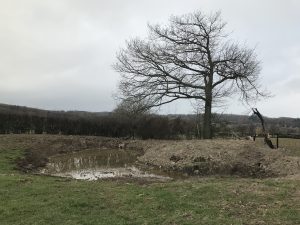
New ponds have been created as part of the Guilsfield Brook demonstrator project
Homes and land surrounding the Guilsfield Brook in Powys are benefiting from lower flood risk after more than 140 nature-based interventions have been put in place as part of a demonstrator water management scheme managed by Shropshire Council.
The Severn Valley Water Management Scheme (SVWMS) commissioned the Severn Rivers Trust (SRT) to undertake the work as part of its demonstrator scheme which champions natural flood management and nature-based solutions.
The leaky dams, ponds and wetlands are among more than 140 natural flood management measures installed by SRT in the Guilsfield Brook – all working together to slow storm water, store it temporarily and ease pressure on the brook during periods of heavy rain.
Brushwood barriers, ponds, and wetlands have been created and excavated to intercept and store some of the stormwater running off into the Nant Rhyd Y Moch brook, which SRT identified as posing a possible flooding risk to lower-lying households.
Dewi Morris, SRT catchment restoration officer, said:-
“We are working on a natural flood management project upstream of these properties.
“There are various measures installed which are designed to push water, falling during high rainfall periods, into the wider woodland. This will lower what we call the flood peak. The water will still reach the Welsh village of Guilsfield, but not at the speed we would normally expect.”
A local resident, speaking on behalf of neighbours, said: –
“On behalf of the local residents, I would like to thank everyone involved for their efforts to reduce the water flow and prevent any possible flood risk to the our homes.
“The techniques being used are environmentally friendly and will enhance the visual outlook of the countryside.”
Tom Dainty, Shropshire Council deputy cabinet member with responsibility for flooding, added:-
“The Guilsfield catchment contains hundreds of hectares of woodland and other natural habitats where leaky dams can safely store water with no risk of increasing flooding to homes.
“If we can do this at a larger scale across the whole of the upper Severn catchment it is an efficient and environmentally friendly way of managing large volumes of water and enhancing resilience within our communities.”
Pete Lambert, SVWMS demonstrator project manager, added:-
“Natural flood management provides simple and effective ways to reduce flooding using natural materials and processes.
“One technique is the strategic placement of large woody debris, creating leaky dams, in watercourses to slow the flow during heavy rainfall events. When used across a catchment, leaky dams can reduce peak flows at a relatively low cost.”
The SVWMS is a cross-border partnership led by the Environment Agency, working with Natural Resources Wales, Powys County Council, and Shropshire Council, and funded by Defra. Its aim is to develop a holistic water management strategy for the Upper Severn, which could serve as a model for similar projects nationwide.
Information and insights learned from the eight demonstrator projects, managed by Shropshire Council, are being used to inform the SVWMS’ emerging water management strategy for the Upper Severn catchment.