
Shropshire Council supports Show Racism the Red Card Day
Shropshire Council is supporting local and national efforts to Show Racism the Red Card through Wear Red Day on Friday 17 October 2025, which comes at the end of Hate Crime Awareness Week.
This year, thoughts during the week are in particular with those who have suffered racism and religious hatred, wherever they live in Shropshire, and whether they are members of staff or members of the public.
The council has been an active participant in this national event ever since 2019, engaging along with trade unions, councils, schools and colleges, and football clubs across the country. The overall aim is to show racism the red card in Shropshire, through visible support for this initiative. This is being achieved through members of staff sending in photos during the week of themselves in red or with red items in the background, to form a visual gallery of support on staff computer screens, with a special design for the day on the screen.
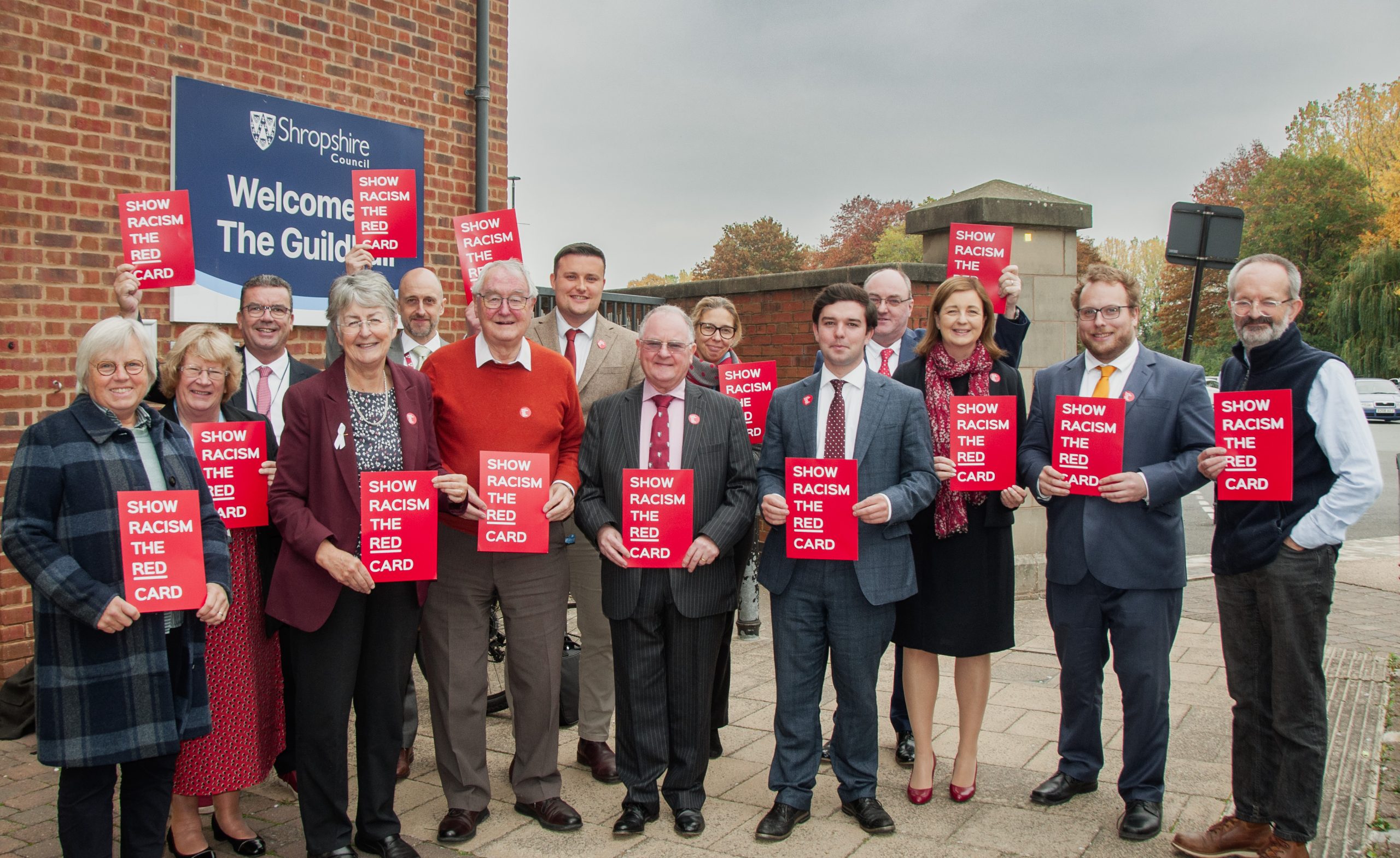
Shropshire Council’s Cabinet, group leaders and executive directors get together to show their support for Show Racism the Red Card.
The council also shares the message “Change hearts, change minds, change lives” in payslips to reach all staff wherever they may work. This message itself then links with the ongoing campaign message across Shropshire and Telford and Wrekin ICS, which comprises health and social care bodies along with Shropshire and Telford and Wrekin councils, that ‘everyone belongs here’.
Heather Kidd, Leader of Shropshire Council, said:
“As leader of this council, I am proud that Shropshire Council councillors and staff across our rural county are showing racism the red card from where they live or work. To do so, through sharing photographs of themselves with red props, dogs wearing red ribbons, or wearing red, costs nothing beyond our time, and shows our commitment to be allies to those who have experienced racism, and to act whenever and wherever we witness or experience it ourselves.
“I am delighted to join with other elected members and executive team in our own show of support for the efforts we must continue to make to tackle racism and other forms of discrimination, harassment and victimisation.
“Racism is a hate crime, and it takes many forms, from overt violence targeted at people of colour, to resistance to discussion, denial that racism exists in our rural county, and microaggressions such as insults and staring. These may be targeted at anyone from one of our many ethnic minorities or at anyone who stands up for someone who is seen to be different.
“With Hate Crime Awareness Week one week within Black History Month, it is timely to also remember and celebrate the achievements and contributions of the black community in the UK. This year’s Black History Month theme of ‘Standing Firm in Power and Pride’ is very much complementary to the Show Racism the Red Card theme, ‘Change hearts, change minds, change lives’. It starts with all of us, working together and standing up together against racism and all forms of discrimination. Everyone belongs here.”
Further information
The anti-racism educational charity Show Racism the Red Card was established in January 1996, thanks in part to a donation by then Newcastle United goalkeeper Shaka Hislop.
In 1990s Newcastle, Shaka was at a petrol station near St James’ Park when he was confronted with a group of young people shouting racist abuse at him. After one of the group realised that they had been shouting at Shaka Hislop, the Newcastle United football player, they came over to ask for an autograph.
It was from this experience that Shaka realised he could harness his status as a professional player to make a difference. Coupled with the power of football and his status as a role model, Shaka thought education could be an effective strategy in challenging racism in society. To this day SRtRC continues to utilise the high-profile status of football and football players to help tackle racism in society and has also expanded into other sports. The majority of the campaign’s work involves the delivery of educational workshops to young people and adults in schools, workplaces and at events held in football stadiums. Across the UK, SRtRC provides educational sessions to more than 50,000 individuals per year.
In UNISON, Black is used to indicate people with a shared history. Black with a capital ‘B’ is used in its broad political and inclusive sense to describe people in Britain that have suffered colonialism and enslavement in the past and continue to experience racism and diminished opportunities in today’s society.
Black History Month was originally founded around thirty years ago to recognise the contributions that people of African and Caribbean backgrounds have made to the UK over many generations. Now, Black History Month has expanded to include the history of not just African and Caribbean people but black people in general.
It is held to highlight and celebrate the achievements and contributions of the black community in the UK. Throughout history, black people have made huge contributions to society in the fields of art, music, science, literature and many more areas.